Transform your business and get ahead of the competition, get ready to learn more about RFID technology; What it is and how it works, being able to implement it in your business.
RFID is defined as a radio signal transcriber, which is capable of transmitting and receiving signals at the same time, with the aim of communicating data to identify a product. Likewise, RFID tags are incorporated into the product and respond to radio frequency.
Radio Frequency Identification (RFID) technology provides real-time data and is used to facilitate most tracking operations while reducing human error.
RFID (Radio Frequency Identification) is a product identification system that may seem similar to a traditional barcode but has great advantages. Unlike the barcode, which uses an image to identify a label placed on a product, RFID uses radio waves to communicate with a microchip, which can be mounted on a large number of supports, such as a tag or label. RFID, a card.
Barcode Site works with leading RFID manufacturers to offer you maximum flexibility, such as Zebra, Datalogic. We offer from fixed, portable to USB RFID readers.
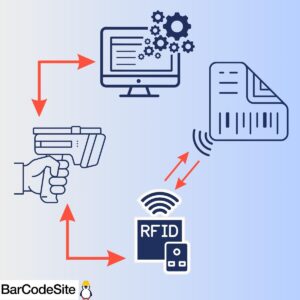
How does an RFID system work?
RFID technology allows you to identify and transmit information about an object through radio frequency waves. Therefore, an RFID tag is needed, which allows you to store, transmit or identify this data. To read this data, an RFID reader and antenna are needed, which will identify the Tag and remotely read the content of the smart tag attached to the object.RFID solutions consist of an RFID antenna, an RFID reader (Transceiver) and an RFID tag (RF-tag).
As the merchandise passes, the antenna detects the Tag or smart label and emits a signal to the reader, who validates the information contained on the label. The reader, in turn, sends the information to the client’s central system, where the data is updated instantly. Data that is transmitted securely, thus reducing possible errors that would otherwise occur.
Applications of RFID technology:
➤RFID in logistics and inventory control: RFID in logistics and inventory control: where the tracking of each of the products that enters and leaves the warehouse, together with those that are returned, must be perfectly documented. An RFID system applied to this area reduces the errors made with other types of systems by almost 100%, without forgetting that the data is obtained instantly, which speeds things up. In this way, RFID tags allow you to optimize time and logistics costs in the facilities that implement them, together with a warehouse management system, automates dozens of processes such as the registration of product receipts or production control without the need for verifications.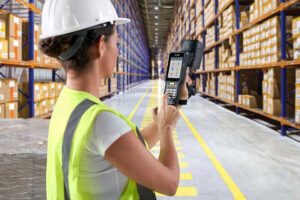
➤RFID in industry: with the special objective of automating processes, reducing errors, execution times and thus improving the working conditions of workers, achieving a more efficient company. To obtain greater productivity, a reduction in direct labor in processes that do not add value to the product and a clear improvement in schedules and forecasts.
➤RFID in stores: Fashion stores were among the first to use this type of labels, with the aim of identifying all products produced, distributed or sold. Nowadays it is also used in other types of stores, such as food stores.

➤RFID in hospitals: for control of medical devices, as well as analyzes and other tests performed on patients. In addition, each patient who enters the hospital will have a code in the form of an RFID tag, from which their entire history can be seen at all times and the tests performed will go with that same number. This avoids possible confusion with other patients.

➤RFID in food: This is a sector where, on the one hand, controlling the packaging and expiration dates are essential to guarantee the safety of the people who consume it, but also the batch numbers of the products, so that they are known at all times. , where it was manufactured, where it was distributed and sold so that, if you have to remove it, it is completely traceable.
➤RFID for access control: both to control the number of people who enter, and to know if the entry they have is false or not.
Advantages of RFID technology:
- ✔Take readings up to a distance of 10 meters.
- ✔You can read multiple articles simultaneously
- ✔Exceptional writing ability to automate activities
- ✔No lines of sight required.
- ✔RFID tags are capable of storing up to 2 KB of information.
- ✔You can differentiate a specific tag from others that are in your “view” range.
- ✔RFID technology reads codes faster.
- ✔Large data storage.
- ✔Great security, since their technology makes them very difficult to duplicate.
- ✔The entire combination of keywords that it has becomes unreadable for other systems such as the EPC.
- ✔The items are updated in real time.
- ✔RFID tags typically have longer durability than traditional barcodes.
- ✔It is usually protected by plastics or other materials that protect the tags effectively.
For more information, do not hesitate to contact us and one of our salespeople will contact you today.
VISIT OUR WEBSITE